I read a report recently that surprised even me about our Canadian healthcare system.
The Canadian Institute for Health Information (CIHI) recently released their Hospital Harm Project results that state, “between 2024 and 2025, one in 17 acute-care hospital stays involved at least one harmful event. In a quarter of those cases, patients experienced more than one.”
They define harm as “an unintended outcome of care that may be prevented with evidence-informed practices and is identified and treated in the same hospital stay.” I think this aspect of our conversation is important to state off the top.
Although a stat like “1 in 17” is startling, we should be wary of a blame-and-shame mentality toward our heroic healthcare workers who are doing their best in a system desperately in need of repair. And I don’t think we’re only talking about Canadian healthcare here either.
No one prepares to become a healthcare professional (HCP) thinking that they’ll harm their patients.
I know I didn’t become a Respiratory Therapist with anything like that in mind. Quite the contrary—anyone becoming a healthcare professional does so with a deep-seated desire to help and heal.
But the reality of a stat related to unintended harm coming to our patients (which ranges from aspiration pneumonias to medication or delivery errors) is that it is happening, and with increasing frequency.
The reasons are multi-faceted, ranging from the all too familiar short-staffing narrative in all areas of care, causing overwhelming workloads on the remaining healthcare team, and a newer factor—the fact that many newly hired HCP’s are being asked to work in higher-risk areas, with patients having higher acuity, being very critically ill, where normally more experienced HCP’s would mentor newer staff gradually into these roles. Take that aspect and throw in twice the workload (or more) that a traditional HCP would take on, and you have a recipe for the kind of report that CIHI has just put out.
The report states that many of these incidents of harm to patients are categorized as “smaller harms,” but ones that can be impactful, nonetheless.
So what is, besides the obvious, the impact of patient harm?
If a patient sustains an unintended episode of harm, that can cause further complications in their condition, create new issues of care that need addressing, and delay their progress to healing and discharge. In fact, the report states, “patients who experience harm stay in hospital almost five times longer, and their care costs more than four times as much.”
That means on average, instead of a 6-day stay, it can turn into as long as 28 days, and instead of costing the system approximately $10,000 for an average stay, that balloons up to $45,000 or more—not to mention the continuous strain this places on staff, dealing with more medically complex concerns, to say nothing of the impact on the wellbeing of the patient.
Nobody wants these kinds of consequences to the health of our patients, the stress this puts on our HCP’s, or the financial burden on a system already groaning under the strain of its own inefficiencies.
One practical area to reduce risk: oxygen delivery and monitoring
This is where respiratory care can quietly become part of the “hospital harm” story—especially in high-pressure environments like ER, med/surg, ICU step-down, procedural areas, and anywhere that oxygen needs are changing quickly.
When teams are stretched thin, the last thing anyone needs is unnecessary complexity at the bedside. If oxygen delivery is confusing, uncomfortable for patients, or requires multiple device changes to meet different needs, it can increase interruptions, variability, and missed steps. And in a world of high acuity and nonstop workload, variability is often where problems start.
At Southmedic, we don’t have any magic bullets to solve all of Canada’s healthcare problems. But there is one area of care we’ve been speaking to for years that we believe is part of this problem: traditional oxygen delivery. We think we can help with a safer solution for patients that’s also more comfortable, less prone to errors and easier to use for clinicians, and one that can save HCP’s time in their already overloaded days.
Oxy₂Mask: clinician flexibility, patient comfort, and safer oxygen delivery
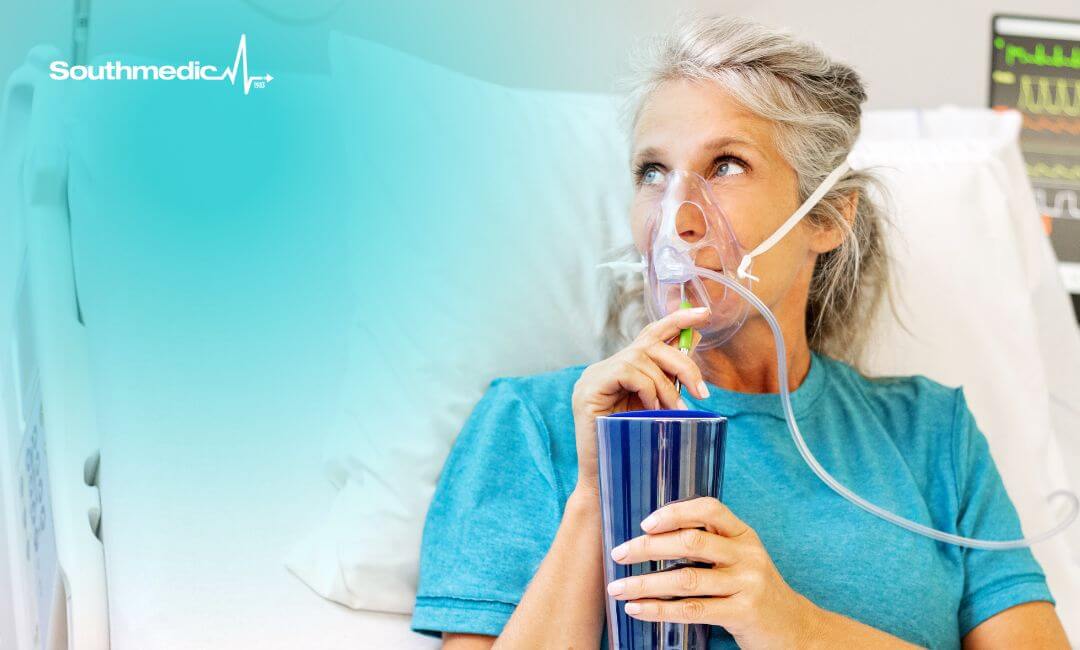
Oxy₂Mask is the original open mask designed to effectively deliver oxygen across a wide range of concentrations—so patients can receive the level of support they need, without clinicians needing to juggle multiple mask types.
Clinician flexibility and efficiency
Tired of juggling multiple oxygen masks that are inflexible and time-consuming? Traditional masks can limit your ability to adjust oxygen concentrations easily, meaning frequent trips to the stock room for different masks and different setups—wasting valuable time. They can also be hot, sweaty, and uncomfortable for patients, which can lead to non-compliance, more frequent alarms, and additional interruptions in your workflow.
Oxy₂Mask’s open design is intended to provide effective oxygen delivery across a wide range of concentrations with just one mask, reducing the need for multiple interfaces. The goal is straightforward: save time, reduce avoidable interruptions, and let clinicians stay focused on patient care.
Patient safety and comfort
Do your patients feel uncomfortable and confined with traditional oxygen masks? Traditional oxygen masks can cause discomfort, restrict movement, and limit normal activities like drinking and talking. They can also introduce risk of CO₂ rebreathing when flows aren’t managed properly, and some interfaces require minimum flow rates that can be missed in real-world conditions.
Oxy₂Mask is designed to improve comfort and allow patients more freedom at the bedside, while supporting oxygen delivery in a way that’s easier to manage in busy clinical environments. With Oxy₂Mask, the aim is to support comfort and safety—without adding complexity.
Procedural sedation: Oxy₂EtCO₂ mask and Oxy₂Pro
If you’re performing procedural sedations, you need both a higher ceiling of FiO₂ capability and a reliable means of capturing capnography—an early warning system for clinicians on the respiratory status of sedated patients.
Oxy₂EtCO₂ mask and Oxy₂Pro utilize Southmedic’s refined Oxy₂ diffuser technology to deliver more oxygen to patients when they need it in the middle of their procedure or post-procedure—helping avoid adverse events and helping procedures stay on track so patients can move along their appropriate care pathway.
Oxy₂EtCO₂ can deliver up to 83% FiO₂ at 15 lpm, while Oxy₂Pro is meant for higher-risk procedural sedation patients, delivering up to 95% FiO₂ at 15 lpm. Couple that with an advanced way to capture end tidal CO₂ waveforms—even at higher oxygen flows—and you’ve got a device intended to support the patient when needed, keeping them safer and reducing the chance of harmful events.
Automated oxygen titration: FreeO₂
Southmedic also distributes the FreeO₂ in Canada, a Canadian-made automated oxygen flowmeter designed to optimize weaning of a patient’s oxygen moment by moment—not only when a clinician can find time to get to the bedside.
Operating under a closed-loop algorithm, tracking a patient’s oxygen saturations (SpO₂) and adjusting to appropriate oxygen flows as needed, FreeO₂ is designed to help keep patients at their prescribed SpO₂ target range and create time efficiencies for clinicians to attend to their most critical needs.
Pair FreeO₂ with Oxy₂Mask—which has no mandatory minimum flow rate and a broad range of FiO₂ delivery—and you have modern oxygen delivery tools intended to reduce the risk that comes from device complexity and real-world workflow pressures, while also helping clinicians feel a little less overwhelmed in the process.
Wrap-up
The CIHI report isn’t a condemnation of healthcare workers—it’s a warning light for the system.
When one in 17 hospital stays involves harm, and when harm drives longer stays, higher costs, and more strain on already stretched teams, it’s a signal that we need practical improvements that reduce complexity and make it easier to deliver consistent care.
We can’t fix staffing overnight.
We can’t fix acuity trends overnight. But we can take steps that reduce friction at the bedside—especially in everyday workflows like oxygen delivery and monitoring—so clinicians can spend less time managing equipment and more time caring for patients.
What leaders can do Monday morning (simple, practical steps)
- Standardize oxygen interfaces for common scenarios to reduce variability between units and shifts.
- Refresh onboarding and quick-reference training for newer staff working in higher-acuity environments.
- Review procedural sedation workflows, especially oxygen delivery + capnography reliability, and identify where complexity causes delays or missed steps.
As always, clinicians should follow local policy, clinical judgment, and patient-specific needs.
Your next steps
To learn more about Oxy₂Mask, visit thebetteroxygenmask.com.
For FreeO₂ information in Canada, visit oxynov.com.
If you’re responsible for respiratory therapy, procedural sedation safety, or standardizing care pathways across units, and you want to reduce bedside complexity without creating another “initiative,” reach out.
We’re happy to walk through where oxygen delivery friction shows up today—and what a safer, simpler setup could look like in your environment.